Entrada Blackwork Embroidery On Your Knits - Rosso Cardinale en Barcelona
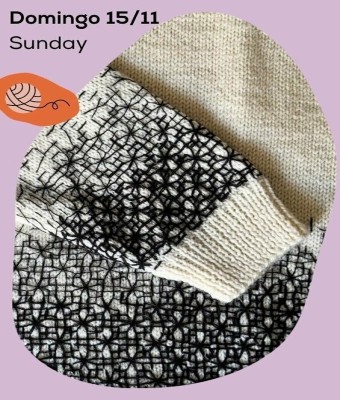
El bordado blackwork es una técnica fascinante que se utiliza tradicionalmente para rellenar formas con patrones geométricos. Sigue un orden preciso de puntadas, que no es difícil pero sí importante para conseguir un reverso limpio y ordenado.
En tela, esta técnica suele trabajarse contando hilos para lograr un diseño uniforme y simétrico. En prendas de punto, en cambio, el papel de calco hace que todo sea mucho más sencillo y divertido. A primera vista puede parecer intrincado, pero en realidad es bastante similar al punto de cruz. En cuanto se empieza, la mayoría de personas lo encuentran fácil de entender.
Idioma: Inglés
Técnica: Bordado
Nivel: Principiante
Conocimientos previos: Estar familiarizado con la técnica y los accesorios de bordado.
Material necesario:
- Hilo de bordar (mouliné) o lana de bordado. Es una buena oportunidad para usar lo que ya tienes en tu stash
- La muestra tejida o uno de los materiales alternativos mencionados
- Agujas de bordado para lana (punta afilada, ojo grande, adecuadas para tu hilo. No usar aguja lanera de punta roma)
- Bastidor de bordado (debe ser más pequeño que la muestra)
- Tijeras pequeñas
- Rotulador negro de punta fina para marcar el diseño
- Papel de calco soluble en agua (también disponible como estabilizador autoadhesivo)
- Libreta y bolígrafo o lápiz para notas
Deberes:
- Antes de la clase, teje una muestra cuadrada en punto jersey (Stockinette) con lana de grosor DK.
- El cuadrado debe medir aproximadamente 22 cm por cada lado. Asegúrate de respetar las medidas, ya que deberá colocarse en un bastidor de bordado y tiene que ser ligeramente mayor que la circunferencia del bastidor. Es recomendable traer un bastidor de 20 cm.
- No olvides planchar la muestra, ya que facilitará el proceso de bordado.
Alternativa a la muestra:
Si no tienes tiempo para tejerla o prefieres no hacerlo, puedes traer una prenda antigua de punto jersey que ya no uses. Puede ser tejida a mano o comprada, siempre que tenga una superficie lisa y quepa en el bastidor. Asegúrate de que la tela no sea demasiado gruesa, para que bordar te resulte cómodo y el resultado sea visible.
También puedes traer un trozo de tela blanca tejida (no de punto), como lino o algodón, con trama firme y uniforme. Será perfecta para practicar la técnica si no deseas trabajar directamente sobre punto.
Patrocinado por: Coruja
**--**
Blackwork embroidery is a fascinating technique traditionally used to fill shapes with geometric patterns. It follows a precise sequence of stitches, which isn’t difficult but is important for achieving a clean, neat reverse side.
On fabric, this technique is usually worked by counting threads to achieve a uniform and symmetrical design. On knitted garments, however, tracing paper makes everything much simpler and more fun. At first it may seem complicated, but it is actually quite similar to cross-stitch. Once you get started, most people find it easy to grasp.
Language: English
Technique: Embroidery
Level: Beginners
Previous knowledge: Be familiar with embroidery techniques and accessories.
Materials required:
- Embroidery thread (mouliné) or embroidery wool. This is a great opportunity to use up what you already have in your stash
- The knitted gauge swatch or one of the alternative materials mentioned
- Embroidery needles for wool (sharp point, large eye, suitable for your thread. Do not use blunt-tipped wool needles)
- Embroidery hoop (it must be smaller than the gauge swatch)
- Small scissors
- Fine-tipped black marker pen to mark out the design
- Water-soluble tracing paper (also available as a self-adhesive stabiliser)
- Printed pattern guide included in the pack (this is sent by Barcelona Knits. I wouldn’t include it)
- Notepad and pen or pencil for notes
Homework:
- Before the class, knit a square swatch in stockinette stitch using DK-weight wool.
- The square should measure approximately 20 cm on each side. Make sure you stick to these measurements, as it will need to be placed in an embroidery hoop and must be slightly larger than the circumference of the hoop. We recommend bringing a 22 cm hoop.
- Don’t forget to iron the swatch, as this will make the embroidery process easier.
Alternative to the swatch:
If you don’t have time to knit it or would rather not, you can bring an old jersey garment that you no longer wear. It can be hand-knitted or shop-bought, provided it has a smooth surface and fits in the hoop. Make sure the fabric isn’t too thick, so that it’s comfortable to embroider and the result is visible.
You can also bring a piece of white woven fabric (not knitted), such as linen or cotton, with a firm, even weave. It will be perfect for practising the technique if you don’t want to work directly on knitted fabric.
Sponsored by: Coruja
Etiquetas
Auditorio, aula 4 Lino | Auditorium, Classroom 4 Linen


